Competency Over Clock Hours: Rethinking How We Train Tomorrow's Midwives
There is a quiet but consequential debate unfolding in maternal health education across the United States. It does not make headlines the way workforce shortages or cesarean rates do, but its implications are equally far-reaching: How should we actually measure whether a midwifery student is ready to practice?
For much of the twentieth century, the answer was straightforward, if imprecise: accumulate enough hours. Attend enough lectures. Complete enough rotations. Log enough deliveries. The assumption embedded in this model was that time in a learning environment is a reliable proxy for clinical readiness. Decades of outcomes data, graduate surveys, and preceptor feedback suggest otherwise.
Competency-based education (CBE) offers a fundamentally different organizing principle. Rather than asking how long a student has been in training, it asks what that student can demonstrably do — and whether they can do it safely, consistently, and with appropriate clinical judgment. For midwifery program directors, curriculum designers, and faculty committed to producing practice-ready graduates, this shift is not merely philosophical. It is structural, and it demands a reimagining of how programs are built from the ground up.
The ACNM Framework: A Foundation, Not a Ceiling
The American College of Nurse-Midwives (ACNM) has articulated a detailed set of core competencies that define the knowledge, skills, and professional behaviors expected of every entry-level certified nurse-midwife (CNM) and certified midwife (CM) in the United States. These competencies, periodically updated to reflect evolving evidence and scope of practice, span the full continuum of midwifery care — from preconception counseling through the postpartum period — and address both technical clinical skills and the relational, ethical, and systems-level dimensions of practice.
For program directors, the ACNM core competencies serve as the non-negotiable foundation of curriculum design. Every learning objective, every clinical rotation assignment, every assessment tool should be traceable back to a specific competency. This alignment is not bureaucratic box-checking; it is the mechanism by which programs can demonstrate — to accreditors, to clinical partners, and ultimately to the public — that their graduates have met a defined and meaningful standard of readiness.
Accreditation through the Accreditation Commission for Midwifery Education (ACME) requires precisely this kind of competency mapping. Programs seeking or maintaining ACME accreditation must show not only that they teach to the ACNM competencies but that they assess student achievement of those competencies in ways that are valid, reliable, and systematically documented. For many programs, moving toward full competency alignment requires a significant overhaul of existing assessment infrastructure.
Designing for Demonstration, Not Duration
The practical translation of CBE principles into midwifery curriculum requires educators to make a series of deliberate design choices that may feel unfamiliar at first.
Begin with the end in mind. Curriculum design in a CBE model starts with the competency, not the content. Before selecting a textbook chapter or scheduling a simulation session, educators should ask: What does a competent entry-level midwife need to be able to do in this domain? What does competent performance look like, and how will we know when a student has achieved it? These questions drive backward design — structuring learning experiences specifically to develop and assess targeted competencies.
Distinguish between knowledge, skill, and judgment. One of the most common pitfalls in midwifery education is conflating these three distinct dimensions of competence. A student may be able to articulate the pharmacological mechanism of oxytocin augmentation without being able to safely manage an augmented labor. A student may demonstrate technically adequate amniotomy technique in simulation without demonstrating the clinical judgment to determine when amniotomy is indicated. Effective CBE programs assess all three dimensions — and use different assessment modalities for each.
Build assessment into the learning process. In a traditional model, assessment is something that happens to students at the end of a unit or rotation. In CBE, formative assessment is continuous, iterative, and directly tied to learning progression. Faculty preceptors in clinical settings should be equipped with structured observation tools — milestone-based checklists, direct observation forms, narrative feedback frameworks — that allow them to document competency development in real time rather than relying on end-of-rotation summaries.
The Role of Simulation in Competency Development
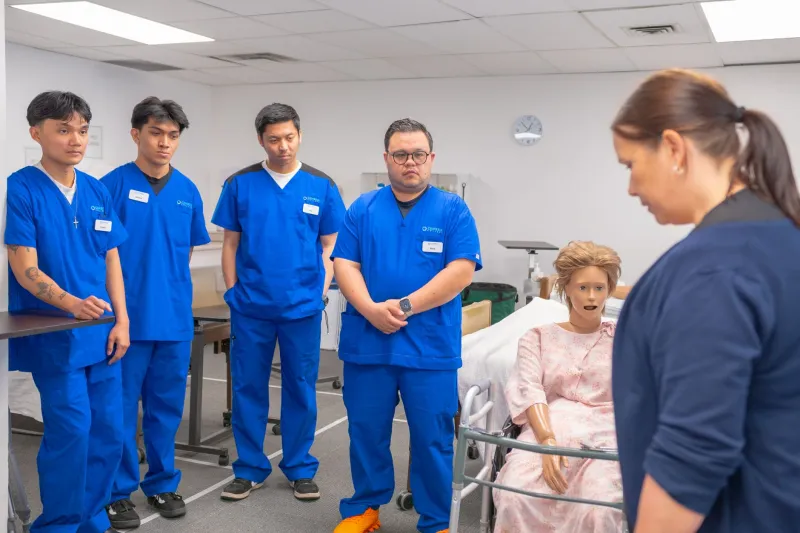
High-fidelity simulation has become an indispensable component of competency-based midwifery training, and for good reason. Simulation environments allow students to encounter high-stakes clinical scenarios — shoulder dystocia, postpartum hemorrhage, neonatal resuscitation — with sufficient frequency and standardization to develop genuine procedural competence before encountering these events in actual practice.
Programs that have successfully integrated simulation into their CBE frameworks share several common features. First, simulation experiences are explicitly linked to specific ACNM competencies, not treated as supplemental enrichment. Second, simulation scenarios are followed by structured debriefing sessions in which faculty guide students through critical reflection on their decision-making processes, not just their technical performance. Third, simulation competency is formally assessed using validated tools, and students who do not meet the established standard are provided with remediation pathways rather than simply advancing on the basis of participation.
The investment required to build and maintain a high-quality simulation program is substantial — in equipment, space, faculty development, and administrative infrastructure. Programs operating with limited resources have found creative solutions, including partnerships with nursing schools and hospital simulation centers, shared equipment agreements with regional programs, and the use of lower-fidelity task trainers for specific skill sets. The key principle is that simulation should be purposefully integrated into the competency architecture of the program, regardless of the resource level at which it is implemented.
Supervised Clinical Hours: Quality Over Quantity
The supervised clinical component of midwifery education is where competency development ultimately must be demonstrated in the complex, unpredictable environment of real practice. Here, the tension between CBE principles and traditional hour-based thinking is most acute.
ACME accreditation standards specify minimum clinical hour requirements, and these requirements exist for sound reasons — adequate exposure to clinical volume is a prerequisite for competency development. However, program directors should resist the temptation to treat hour accumulation as the primary metric of clinical readiness. Two students who have each completed the same number of supervised clinical hours may have vastly different competency profiles, depending on the quality of supervision they received, the range of clinical experiences to which they were exposed, and the degree to which their preceptors engaged in active, structured teaching.
Investing in preceptor development is therefore not optional in a high-quality CBE program. Clinical faculty must understand the competency framework, know how to use assessment tools consistently, and be prepared to provide the kind of specific, actionable feedback that drives learning. Programs that treat clinical placements as logistical arrangements — rather than as pedagogically structured learning environments — will struggle to produce graduates whose competency is genuinely verifiable.
A Practical Framework for Program Directors
For educators and administrators considering a transition toward competency-based program architecture, the following sequence provides a workable starting point:
- Audit existing curriculum against ACNM core competencies. Identify gaps, redundancies, and areas where assessment currently does not address the competency it purports to measure.
- Develop or adopt validated assessment tools for each major competency domain, ensuring tools are appropriate to the assessment context (simulation, clinical observation, written examination, OSCE).
- Establish clear progression standards. Define what level of performance constitutes readiness to advance at each stage of the program, and build remediation pathways for students who do not meet those standards.
- Invest in faculty development. Ensure that both didactic and clinical faculty understand CBE principles and can implement assessment tools with consistency and fidelity.
- Build a data infrastructure. Competency-based programs generate rich longitudinal data on student performance. Programs that systematically analyze this data are better positioned to identify curriculum weaknesses, support struggling students early, and demonstrate program effectiveness to accreditors.
The Obligation to Do Better
The midwives trained in American programs today will be practicing for the next three to four decades. The communities they serve — including those most affected by the United States' persistent disparities in maternal health outcomes — deserve practitioners whose readiness has been verified against rigorous, evidence-aligned standards.
Competency-based education is not a trend or a compliance strategy. It is a more honest and more rigorous answer to the question that every midwifery program must ultimately be able to answer: Are our graduates truly ready to practice? At Birth Academy, that question is the animating force behind every curriculum decision, every assessment tool, and every conversation about what excellent midwifery education looks like in practice.