The Science of Presence: How Continuous Labor Support Reshapes Birth Outcomes
In an era when obstetric technology continues to advance at a remarkable pace, it may seem counterintuitive that one of the most powerful tools available to birth professionals requires no equipment, no prescription, and no procedural training. Yet the research literature has spoken clearly for more than three decades: the sustained, attentive presence of a knowledgeable support person during labor produces outcomes that many pharmacological and procedural interventions struggle to match.
Understanding the evidence behind continuous labor support is not merely an academic exercise. For midwives, nurses, doulas, and obstetric educators in the United States, it represents a clinical and ethical imperative — one that has direct implications for how programs are designed, how practitioners are trained, and how care is ultimately delivered.
What the Landmark Research Tells Us
The foundational evidence base for continuous labor support is substantial and well-replicated. The Cochrane Collaboration, widely regarded as the gold standard for systematic reviews in healthcare, has published multiple iterations of its landmark meta-analysis on this subject. The most recent comprehensive review, encompassing data from more than 15,000 participants across 26 randomized controlled trials, found that women who received continuous support during labor were more likely to have a spontaneous vaginal birth, less likely to use intrapartum analgesia, and reported higher levels of satisfaction with their birth experience.
Specifically, the data demonstrated a 25 percent reduction in cesarean delivery rates, a 10 percent decrease in the use of any pharmacological pain relief, and a 31 percent reduction in the likelihood of reporting dissatisfaction with the birth experience. These are not marginal improvements. In a healthcare environment where cesarean rates in the United States hover near 32 percent — well above the World Health Organization's recommended threshold — findings of this magnitude carry significant clinical weight.
Equally important are the postpartum implications. Several trials have identified associations between continuous labor support and reduced incidence of postpartum depressive symptoms. While causality is difficult to establish definitively in observational data, the proposed mechanism is consistent with broader psychoneuroendocrinological research: positive birth experiences, characterized by a sense of control and emotional safety, appear to buffer against the dysregulation of stress-response systems that underlies perinatal mood disorders.
The Physiology Beneath the Statistics
To fully appreciate why continuous support exerts such a powerful influence on labor, practitioners must look beyond behavioral outcomes and examine the underlying physiological pathways.
Labor is governed in large part by the neuroendocrine system. Oxytocin, the primary hormone driving uterine contractions, is profoundly sensitive to environmental and emotional stimuli. Under conditions of perceived threat or psychological distress, the hypothalamic-pituitary-adrenal axis activates, elevating cortisol and catecholamine levels. These stress hormones are functionally antagonistic to oxytocin, inhibiting its release and disrupting the coordinated uterine activity necessary for efficient cervical dilation and fetal descent.
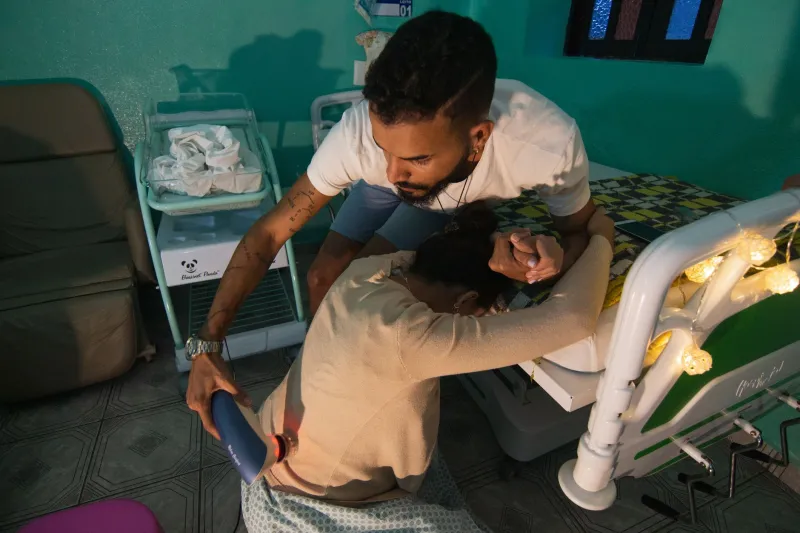
Continuous emotional and physical support — through reassurance, informed explanation, comfort measures such as counter-pressure and positioning, and the simple act of uninterrupted companionship — activates the parasympathetic nervous system. This neurological shift reduces the stress response, facilitates endogenous oxytocin production, and creates the physiological conditions under which labor can progress most effectively. In this sense, the doula or trained support partner is not merely providing comfort; they are actively modulating the hormonal environment of labor.
This mechanism also helps explain why the source of support matters. The Cochrane review found that continuous support provided by someone who was neither a member of the hospital staff nor part of the laboring person's social network — that is, a trained doula or birth companion — produced the largest measurable effect. Researchers hypothesize that this reflects the unique combination of clinical knowledge and undivided attention that a trained professional can offer, unconstrained by institutional obligations or personal emotional investment.
Who Provides Support, and How It Matters
The composition of the support team is a nuanced variable that birth professionals should understand clearly. The research distinguishes between three primary categories of support provider: hospital staff (nurses, midwives), social support persons (partners, family members), and trained lay support persons (doulas, birth companions).
While all forms of support confer some benefit relative to no support, trained lay support consistently produces the most robust outcomes across multiple endpoints. This does not diminish the vital role of the labor and delivery nurse or the certified nurse-midwife; rather, it underscores the value of a dedicated presence whose sole responsibility is the continuous support of the laboring individual.
For birth professionals working in hospital settings, this distinction has practical implications. Nursing staff carry essential clinical responsibilities — fetal monitoring, medication administration, documentation — that necessarily interrupt sustained presence. Recognizing this structural reality, rather than viewing it as a failure, allows care teams to advocate more effectively for doula integration within institutional protocols.
Translating Evidence Into Practice
For educators and practitioners at every level, the challenge lies in operationalizing this evidence within the varied realities of American birth settings, from academic medical centers to freestanding birth centers to home birth practices.
Several strategies have demonstrated effectiveness in clinical and educational contexts:
Structured comfort measure training. Birth professionals should receive formal instruction in evidence-based physical support techniques, including hydrotherapy, ambulation support, labor positioning, massage, and acupressure. These are teachable, reproducible skills that can be standardized across training programs.
Communication frameworks. The ability to provide emotionally attuned, clear, and non-directive communication is a learnable competency. Training programs that incorporate simulation exercises focused on verbal and nonverbal support behaviors prepare practitioners for the relational demands of intrapartum care.
Institutional advocacy. Program graduates should be equipped not only with clinical skills but also with the knowledge to advocate for policies that support continuous care — including doula-friendly visitation policies, open birth plans, and interdisciplinary team models that explicitly include trained support persons.
Postpartum follow-through. The evidence connecting positive birth experiences to reduced postpartum depressive symptoms argues for continuity of care models in which support relationships are not severed at delivery. Practitioners trained to recognize the emotional arc of the perinatal period are better positioned to provide holistic, prevention-oriented care.
A Call to Evidence-Based Integration
The research on continuous labor support represents one of the most consistent and clinically meaningful bodies of evidence in all of perinatal care. For birth professionals committed to evidence-based practice, it is no longer sufficient to acknowledge this literature in passing. The obligation is to actively embed its findings into training curricula, institutional protocols, and individual clinical behavior.
At Birth Academy, the principle that excellent maternal care is grounded in rigorous science is foundational. The evidence for continuous labor support is not a soft finding from a peripheral field — it is a central pillar of what it means to provide excellent, person-centered intrapartum care. Practitioners who understand this science, and who can apply it with skill and compassion, are the professionals that the next generation of birthing families deserves.