Pressure Points: How Clinical Training Programs Are Failing Providers—and Patients—in Hypertensive Pregnancy Management
In the landscape of maternal mortality, hypertensive disorders of pregnancy occupy a prominent and deeply troubling position. According to the Centers for Disease Control and Prevention, preeclampsia and related conditions account for a significant proportion of pregnancy-related deaths in the United States—deaths that public health researchers consistently classify as preventable. Yet despite decades of clinical evidence, national alerts from bodies such as the Alliance for Innovation on Maternal Health (AIM), and federally funded safety bundles designed to standardize care, one factor continues to receive insufficient scrutiny: the quality of provider education itself.
Blood pressure management during pregnancy is not a peripheral competency. It is a foundational clinical skill. And the evidence increasingly suggests that the way US maternal health training programs teach—or fail to teach—hypertensive disorders is contributing directly to delayed recognition, inconsistent intervention, and avoidable harm.
A Curriculum That Treats Urgency as an Afterthought
Ask any practicing midwife or labor and delivery nurse how much dedicated, structured instruction they received on hypertensive disorders of pregnancy, and the answers are often sobering. Most will describe scattered lectures, a chapter in a textbook, or a simulation exercise that touched on eclampsia without meaningfully exploring the clinical terrain that precedes it.
This fragmentation is not incidental. It reflects a broader tendency in maternal health curricula to concentrate teaching time on labor mechanics, fetal surveillance, and delivery management while treating systemic complications as supplementary material. The result is a workforce that can identify a classic presentation of severe preeclampsia—sudden-onset headache, visual disturbances, blood pressure readings above 160/110 mmHg—but struggles to recognize the subtler, earlier clinical signals that, if acted upon, might prevent escalation entirely.
Subtle presentations are, in fact, the norm. Gestational hypertension may develop gradually. Blood pressure readings that fall just below severe-range thresholds can persist unaddressed because providers lack clear, internalized criteria for when watchful waiting ends and urgent intervention begins. Proteinuria may be absent in a significant proportion of preeclampsia cases, a clinical reality that many programs still do not adequately emphasize. Atypical symptoms—epigastric pain, new-onset thrombocytopenia, elevated liver enzymes—are frequently absent from structured teaching scenarios, leaving providers ill-equipped to connect these findings to a unifying hypertensive diagnosis.
Threshold Uncertainty: The Gap Between Knowledge and Action
One of the most consequential deficiencies in current training is the failure to translate clinical thresholds into practiced, reflexive decision-making. Knowing that a blood pressure of 160/110 mmHg requires antihypertensive treatment within a defined time window is categorically different from acting on that knowledge under the pressure of a busy labor unit, with a physician who is unavailable, a patient who is anxious, and a team that has not rehearsed the protocol together.
The AIM Severe Hypertension in Pregnancy bundle—developed specifically to address these gaps at the institutional level—was designed in part because providers were demonstrably hesitant to initiate treatment even when clinical criteria were met. That hesitancy does not emerge from indifference. It emerges from insufficient preparation. When training programs fail to provide repeated, scenario-based practice with intervention thresholds, providers are left to construct their own mental frameworks on the job, often during moments when there is no margin for uncertainty.
Simulation-based learning, when implemented rigorously, has demonstrated measurable improvements in provider response times and protocol adherence in hypertensive emergencies. Yet access to high-fidelity simulation for hypertensive scenarios remains uneven across nursing and midwifery programs, particularly in programs with limited resources or clinical placement partnerships that do not prioritize this content.
Measurement Errors and the Overlooked Technical Foundation
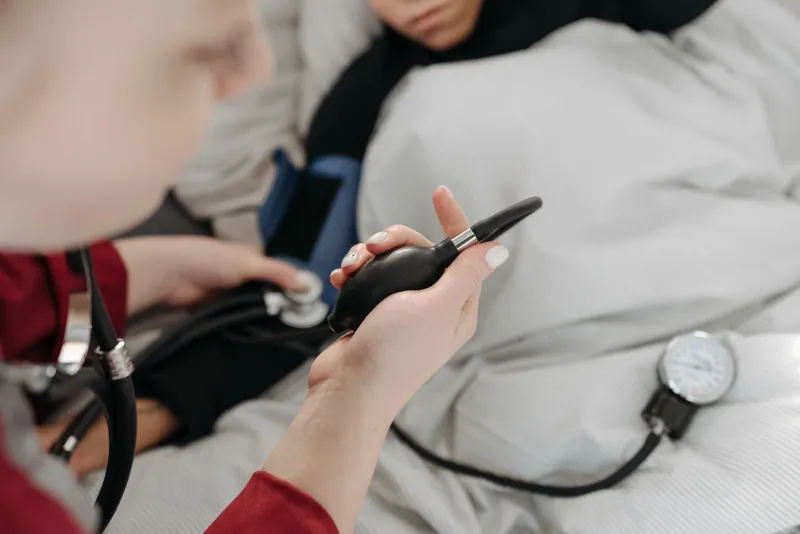
Any honest examination of hypertensive disorder education must also confront a technical gap that is almost embarrassingly basic: blood pressure measurement technique. Studies have consistently demonstrated that improper cuff sizing, patient positioning, and timing of readings contribute to both over- and underdiagnosis of hypertension in pregnancy. A patient measured with a cuff that is too small while seated upright immediately after walking to the triage room may receive a reading that triggers unnecessary intervention. A patient measured incorrectly in the opposite direction may be falsely reassured.
Few training programs dedicate structured time to blood pressure measurement accuracy as a distinct clinical competency in the obstetric context. It is assumed to have been learned elsewhere, in foundational nursing or midwifery coursework, and therefore not revisited. This assumption is costly. Establishing institutional-level accuracy requires that every provider on a unit apply the same technique under the same conditions—and that consistency begins in training.
The Psychological Dimension: Preparing Providers to Support, Not Just Monitor
A hypertensive pregnancy diagnosis carries weight that extends well beyond the clinical. For many patients, learning that their blood pressure is elevated—and that this elevation may require hospitalization, early delivery, or close monitoring for weeks—is destabilizing. Anxiety, grief over a birth plan that must be revised, fear about fetal wellbeing, and confusion about what the diagnosis means in practical terms are all common responses. They are also responses that can affect clinical outcomes, as stress and psychological distress have documented physiological effects on blood pressure itself.
Yet training programs rarely address the communication and psychosocial dimensions of hypertensive diagnosis with the same rigor applied to clinical management. Providers are taught to detect and treat; they are seldom taught to explain, reassure, or navigate the emotional complexity of a patient who feels that her body has become a source of danger. This omission is not trivial. A provider who is skilled at reading a blood pressure trend but unprepared to help a patient understand why she is being transferred to a higher level of care—or why her planned midwifery-led birth must now involve obstetric consultation—is only partially equipped for the clinical encounter.
Effective communication in these moments requires preparation. It requires exposure to real and simulated conversations, feedback from experienced practitioners, and the opportunity to practice delivering difficult information with clarity and compassion. Without that preparation, providers improvise—and patients are left to make sense of a frightening diagnosis without adequate support.
Rebuilding the Educational Framework
Addressing these gaps requires more than adding a lecture or updating a syllabus. It requires a structural commitment to treating hypertensive disorders of pregnancy as a priority clinical domain deserving of dedicated, sequenced, and regularly assessed instruction.
This means integrating threshold-based decision-making into simulation curricula. It means revisiting blood pressure measurement as a technical skill subject to ongoing evaluation. It means ensuring that atypical presentations receive the same attention as classic ones. And it means embedding patient communication and psychosocial support into hypertension-related training modules, not as optional enrichment, but as core competencies.
For institutions seeking to benchmark their curricula against national standards, the AIM bundle and the guidance published by the American College of Obstetricians and Gynecologists offer a starting point. But benchmarking alone is insufficient. What is required is the honest recognition that current preparation is not meeting the clinical moment—and that the patients who experience preventable complications from delayed or inadequate hypertensive management deserve a better-prepared workforce than many programs are currently producing.
The vital sign has been neglected long enough. It is time to treat blood pressure education in pregnancy with the urgency that the clinical evidence has always demanded.