From Theory to Touch: Building Measurable Clinical Competency in Non-Pharmacologic Labor Support
Ask a group of newly graduated labor and delivery nurses or certified nurse-midwife students whether they know what hydrotherapy is, and nearly all of them will say yes. Ask them to demonstrate a counter-pressure technique on a laboring patient, or to coach a breathing pattern through a sixty-second contraction, and the confidence level drops sharply. This disconnect—between knowing and doing—is one of the most persistent and consequential gaps in maternal health education today.
Non-pharmacologic pain management is not a fringe approach to labor support. It is a well-documented, evidence-supported dimension of comprehensive obstetric care. Systematic reviews published in the Cochrane Database have found that continuous support, immersion in water, massage, and movement-based interventions are associated with reduced epidural uptake, shorter labor duration, and higher rates of maternal satisfaction. These are not trivial outcomes. Yet in many US training programs, these techniques are introduced conceptually and assessed—if at all—through written examination rather than observed clinical performance.
The result is a generation of practitioners who can define hydrotherapy but hesitate to draw a birth tub, who understand the gate-control theory of pain but freeze when asked to guide a patient through a position change at the height of transition.
Why the Confidence Gap Exists
Understanding why this gap develops is essential to closing it. Several structural features of current training programs contribute to the problem.
Pharmacologic options receive disproportionate instructional weight. Epidural analgesia, IV opioids, and nitrous oxide administration are taught with considerable rigor in most programs—students learn mechanisms of action, dosing protocols, contraindications, and monitoring requirements. Non-pharmacologic techniques, by contrast, are often grouped into a single session framed around patient preference rather than clinical skill. The implicit message is that medication is the default and everything else is supplementary.
Simulation resources are concentrated elsewhere. High-fidelity simulation in maternal health education has expanded significantly, but most simulation investment has gone toward emergency scenarios: shoulder dystocia, postpartum hemorrhage, eclampsia. Labor support skills—which require a different kind of simulation, one centered on communication, physical guidance, and sustained presence—are rarely built into simulation curricula with the same rigor.
Clinical environments do not always model the full range of options. A trainee completing rotations at a high-volume urban hospital where the epidural rate exceeds 80 percent may rarely observe non-pharmacologic techniques used in sustained, skilled ways. Without mentors who actively demonstrate these methods and create space for trainees to practice them, the knowledge remains inert.
Designing Instruction That Builds Real Skill
Effective education in non-pharmacologic labor support requires moving away from passive content delivery and toward active, embodied learning. The following framework offers a structured approach that maternal health educators can adapt to their program contexts.
Teach the Physiology First, Then the Technique
Trainees who understand why a technique works are more likely to apply it flexibly and confidently. Before introducing positioning, for example, educators should ensure students have a working grasp of how fetal position affects labor progress, how pelvic architecture changes with movement, and how proprioceptive stimulation interacts with pain signaling. This physiological grounding transforms technique from a rote procedure into a reasoned clinical choice.
The same applies to breathing and relaxation strategies. When trainees understand the relationship between sympathetic nervous system activation and pain perception, slow-paced breathing and relaxation cues become logical interventions rather than soft suggestions.
Build a Skills Laboratory Specific to Labor Support
Programs should develop dedicated simulation sessions for non-pharmacologic techniques, separate from emergency obstetric drills. These sessions should include:
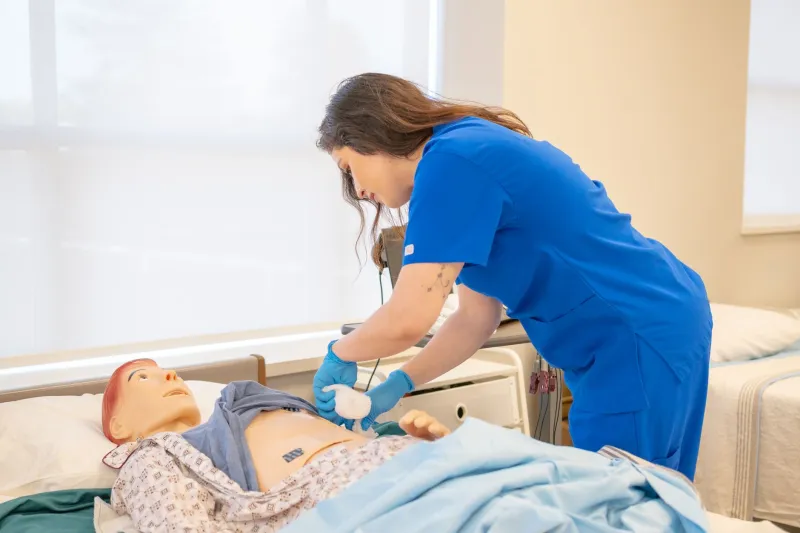
- Positioning practice using simulation mannequins or standardized patients, with trainees moving through hands-and-knees, lateral recumbent, and upright positions while articulating the clinical rationale for each
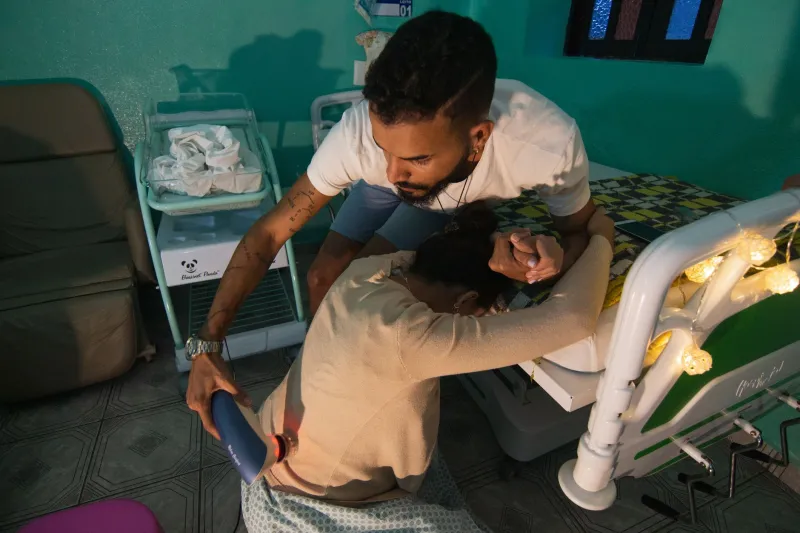
- Counter-pressure and massage taught with direct hands-on practice and peer feedback, with attention to technique, pressure, and verbal communication during application
- Hydrotherapy orientation that familiarizes trainees with water immersion protocols, monitoring adaptations, and contraindication assessment—even if a live birth tub is unavailable, simulation can address the clinical decision-making
- Breathing and vocalization coaching, practiced through timed simulated contractions with a facilitator providing real-time feedback on pacing, tone, and responsiveness
Each skill should be assessed using a structured competency checklist, not a global impression. Checklists should specify observable behaviors: does the trainee maintain eye contact, adjust technique based on patient feedback, verbalize what they are doing and why?
Integrate Emotional Support as a Clinical Skill
One of the most consistent findings in labor support research is that the quality of the relational presence a clinician offers is as clinically significant as any physical technique. Yet emotional support is rarely taught as a structured skill in US programs. Educators should address this directly.
Simulation scenarios should include patients who are frightened, dissatisfied with their experience, or expressing ambivalence about their pain management choices. Trainees should practice therapeutic communication under pressure—not as a personality trait, but as a learnable, assessable clinical behavior. Frameworks such as NURSE (Name, Understand, Respect, Support, Explore) offer structured language that can be taught, practiced, and evaluated.
Pair Simulation with Structured Clinical Mentorship
Skill acquisition in the simulation lab must be reinforced in the clinical environment. Programs should establish formal mentorship agreements with clinical preceptors who are trained—and expected—to actively demonstrate and supervise non-pharmacologic techniques. This requires more than a general preceptorship agreement. It requires explicit documentation of which techniques a trainee has been observed practicing and supervised in, with a minimum number of supervised applications before independent performance is permitted.
Clinical coordinators should review mentorship logs regularly and flag trainees who are completing rotations without documented exposure to the full range of labor support methods.
Measuring Competency With Appropriate Standards
Competency in non-pharmacologic labor support should be defined with the same specificity applied to procedural skills. Programs should establish clear benchmarks: a trainee should be able to demonstrate at least three positioning strategies with correct technique and verbal rationale, coach a patient through a simulated contraction using a structured breathing pattern, and apply counter-pressure correctly on a standardized patient before clinical placement.
Post-clinical self-assessment surveys and objective structured clinical examinations (OSCEs) can both serve as evaluation tools. What matters is that the assessment is behavioral and observed, not self-reported or inferred from written test performance.
Expanding the Definition of Skilled Birth Support
The profession of midwifery has long held non-pharmacologic support at its philosophical center. But philosophy without pedagogy does not produce clinical competency. As maternal health education in the United States continues to evolve, training programs have an obligation to ensure that every graduate—regardless of practice setting—can offer skilled, evidence-informed, non-pharmacologic support to laboring patients.
This is not about ideology. It is about preparing practitioners who can meet patients where they are, with the full range of tools the evidence supports—and the hands-on confidence to use them.