The Bonding Imperative: Rethinking Immediate Maternal-Newborn Contact in the Surgical Suite
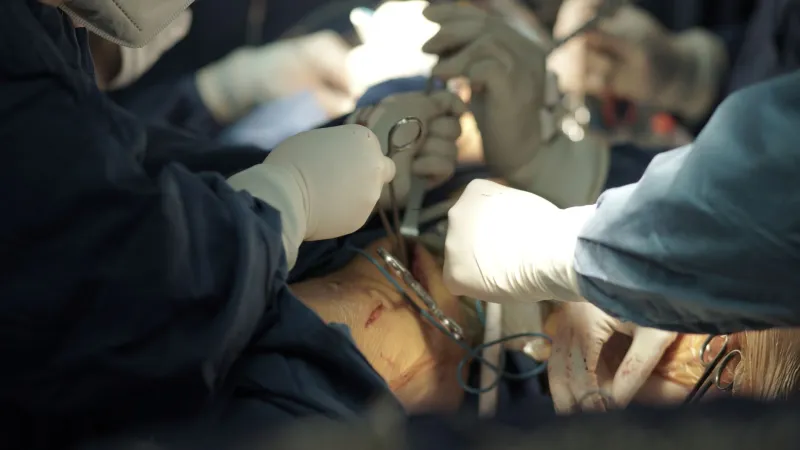
For decades, the operating room has been treated as a space governed almost exclusively by surgical logic—sterile fields, instrument counts, and anesthetic monitoring. The laboring person on the table, and the infant delivered from them, have too often been processed within that framework rather than centered within it. The result is a clinical culture in which mother-infant separation following cesarean birth has become so normalized that many practitioners do not recognize it as a departure from evidence-based care. It is time for maternal health training programs to correct that assumption, equipping the next generation of clinicians with the knowledge, skills, and institutional confidence to facilitate immediate bonding in the surgical suite.
Why Separation Became the Default
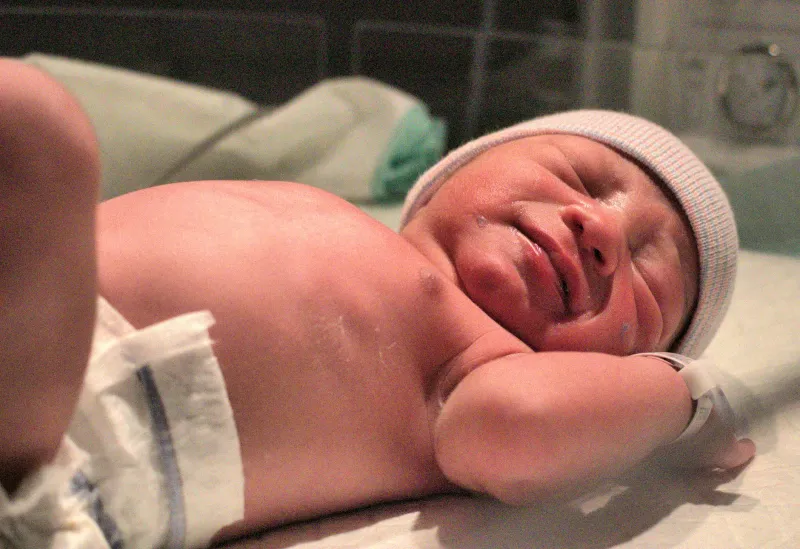
The practice of separating newborns from their mothers after cesarean delivery emerged largely from practical concerns: warming under radiant heat, initial newborn assessment, and the perceived incompatibility of skin-to-skin contact with a sterile operative field. These rationales were rarely interrogated against evidence because, for much of the twentieth century, little existed. Routine separation was not a policy choice so much as an institutional habit, passed from one generation of clinicians to the next through training environments that modeled separation as standard.
The problem is that habits become curricula. When student midwives, nursing students, and obstetric residents rotate through labor and delivery units where cesarean births routinely result in the infant being whisked to a warmer across the room, they internalize that sequence as correct. No one needs to teach it explicitly; the environment teaches it implicitly. Disrupting this cycle requires deliberate, evidence-informed instruction at the program level.
What the Evidence Demonstrates
The physiological case for early skin-to-skin contact—frequently termed kangaroo care in the neonatal context—is well established across vaginal birth literature, and an expanding body of research confirms its applicability to surgical delivery. When a newborn is placed skin-to-skin on the maternal chest following cesarean birth, several measurable outcomes improve.
Thermoregulation is among the most clinically immediate. Newborns lose heat rapidly in the cool temperatures typical of operating rooms, and radiant warmers, while effective, cannot replicate the dynamic thermal regulation provided by maternal body contact. Studies have demonstrated that infants held skin-to-skin following cesarean birth maintain temperature at least as effectively as those placed under radiant heat, with some evidence suggesting superior stability.
Breastfeeding initiation is similarly affected. Early skin-to-skin contact activates feeding cues and supports the hormonal cascade—particularly oxytocin release—that underpins successful lactation. Cesarean-born infants who experience immediate maternal contact show higher rates of breastfeeding initiation and longer duration compared to those who are separated, even briefly. Given that cesarean birth is already associated with lower breastfeeding rates in the United States, this is not a trivial clinical consideration.
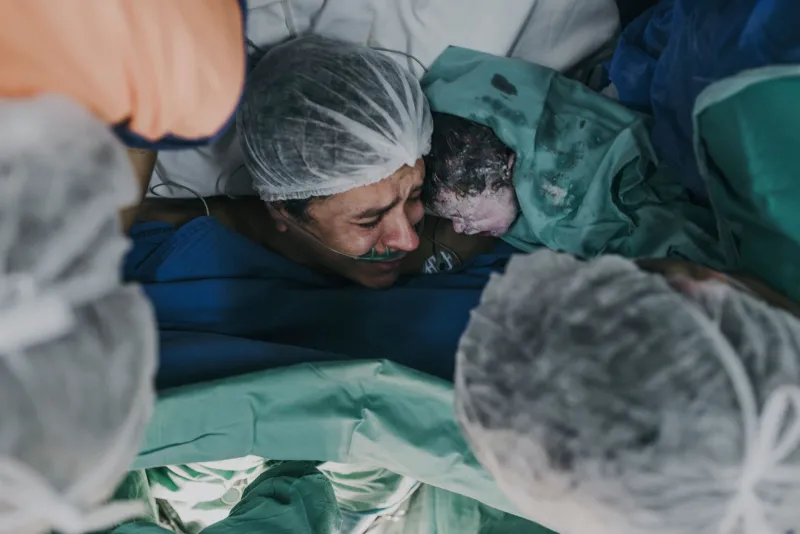
Perhaps most compelling for maternal health professionals is the growing evidence linking early skin-to-skin contact after surgical birth to improved postpartum mental health outcomes. Cesarean delivery, particularly when unplanned, carries elevated risk for postpartum depression and post-traumatic stress symptoms. Facilitating immediate bonding does not eliminate those risks, but it appears to buffer against them by reinforcing the birthing person's sense of agency and connection at a moment when the surgical environment can otherwise feel disempowering.
Delayed Cord Clamping: An Overlooked Opportunity in the OR
Delayed cord clamping (DCC) has become increasingly standard following vaginal birth in the United States, supported by recommendations from the American College of Obstetricians and Gynecologists and the American Academy of Pediatrics. Its benefits—improved iron stores, better neurodevelopmental outcomes, and higher hemoglobin levels in the newborn period—are well documented.
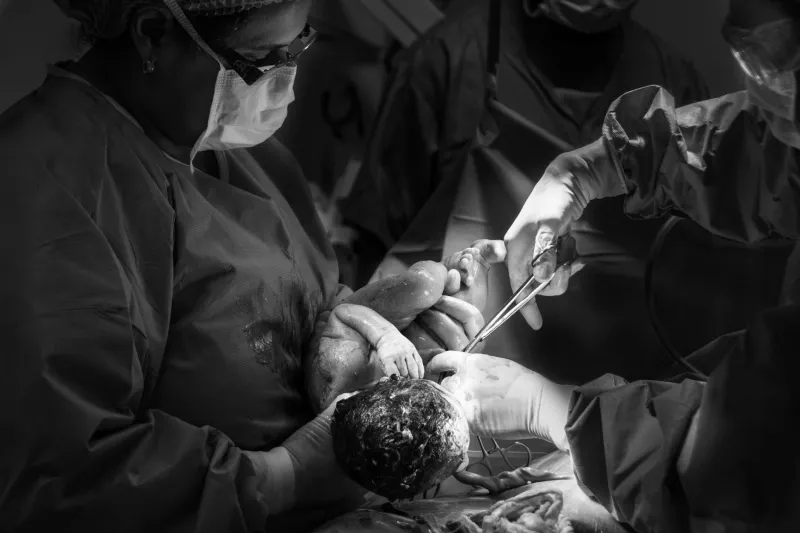
Yet DCC remains inconsistently practiced following cesarean delivery. Logistical assumptions about surgical efficiency and concerns about uterine closure timing have perpetuated the belief that the cord must be clamped immediately at cesarean birth. Evidence does not support this assumption. Modified approaches, including the use of an extended sterile drape that allows the infant to be placed on the maternal thighs while the cord continues to pulse, have been successfully implemented at institutions across the country. Maternal health training programs that omit this content leave graduates unprepared to advocate for or facilitate DCC in the surgical context.
Teaching the Techniques: What Curricula Must Include
Facilitating skin-to-skin contact in the operating room is not simply a matter of intention—it requires specific technical knowledge that must be taught explicitly. Training programs should address several distinct competency areas.
Modified positioning and draping. Standard cesarean draping obscures the mother's view of and access to her infant. Modified draping protocols, sometimes called the "natural cesarean" or "family-centered cesarean" approach, lower or use transparent drapes to allow the birthing person to witness the birth and receive their infant onto their chest. Clinicians need to understand how these modifications are implemented without compromising sterile technique.
Thermoregulation in the OR environment. Operating rooms are typically maintained at temperatures that prioritize surgical staff comfort and infection control, not newborn thermoregulation. Training should address strategies for warming the maternal chest prior to delivery, using warm blankets over the infant once placed, and monitoring temperature continuously during skin-to-skin contact in this environment.
Collaborative OR team communication. The feasibility of immediate skin-to-skin contact following cesarean birth depends heavily on interdisciplinary coordination. Obstetric providers, anesthesiologists, scrub technicians, and neonatal nurses must all operate within a shared framework that treats maternal-newborn contact as a clinical priority rather than an inconvenience. Training programs should include simulation-based exercises that practice this communication explicitly, preparing graduates to advocate for bonding protocols within surgical teams.
Identifying contraindications clearly. Not every cesarean birth will permit immediate skin-to-skin contact, and training must equip clinicians to distinguish genuine contraindications—significant maternal hemodynamic instability, newborns requiring immediate resuscitation—from assumed barriers rooted in habit. When contact is not immediately possible, programs should teach strategies for facilitating early transfer of the infant to a support person and for resuming skin-to-skin contact at the earliest safe opportunity.
Institutional Inertia as a Curriculum Problem
One of the most significant barriers to immediate skin-to-skin contact following cesarean birth in the United States is not clinical evidence—it is institutional culture. Many hospitals maintain protocols that reflect older assumptions, and individual clinicians, even those who understand the evidence, may feel ill-equipped to challenge those norms.
This is precisely why the educational context matters. When maternal health training programs frame OR bonding not as an optional enhancement but as a clinical standard consistent with evidence-based care, they send graduates into practice with the professional grounding to advocate for change. They also send a message to the institutions that host clinical rotations: these learners expect to see evidence-based cesarean care, and their training programs have prepared them to recognize when they do not.
Conclusion
The operating room is not a space exempt from the principles of family-centered, evidence-based maternity care. Cesarean birth is birth—and the physiological imperatives of thermoregulation, early feeding, hormonal bonding, and postpartum mental health do not pause because a surgical incision is involved. Maternal health training programs that fail to teach OR bonding protocols are not simply omitting a technical skill. They are perpetuating a clinical culture that places procedural convenience above patient outcomes. Preparing graduates to facilitate immediate maternal-newborn contact in the surgical suite is not aspirational curriculum design. It is a professional obligation.